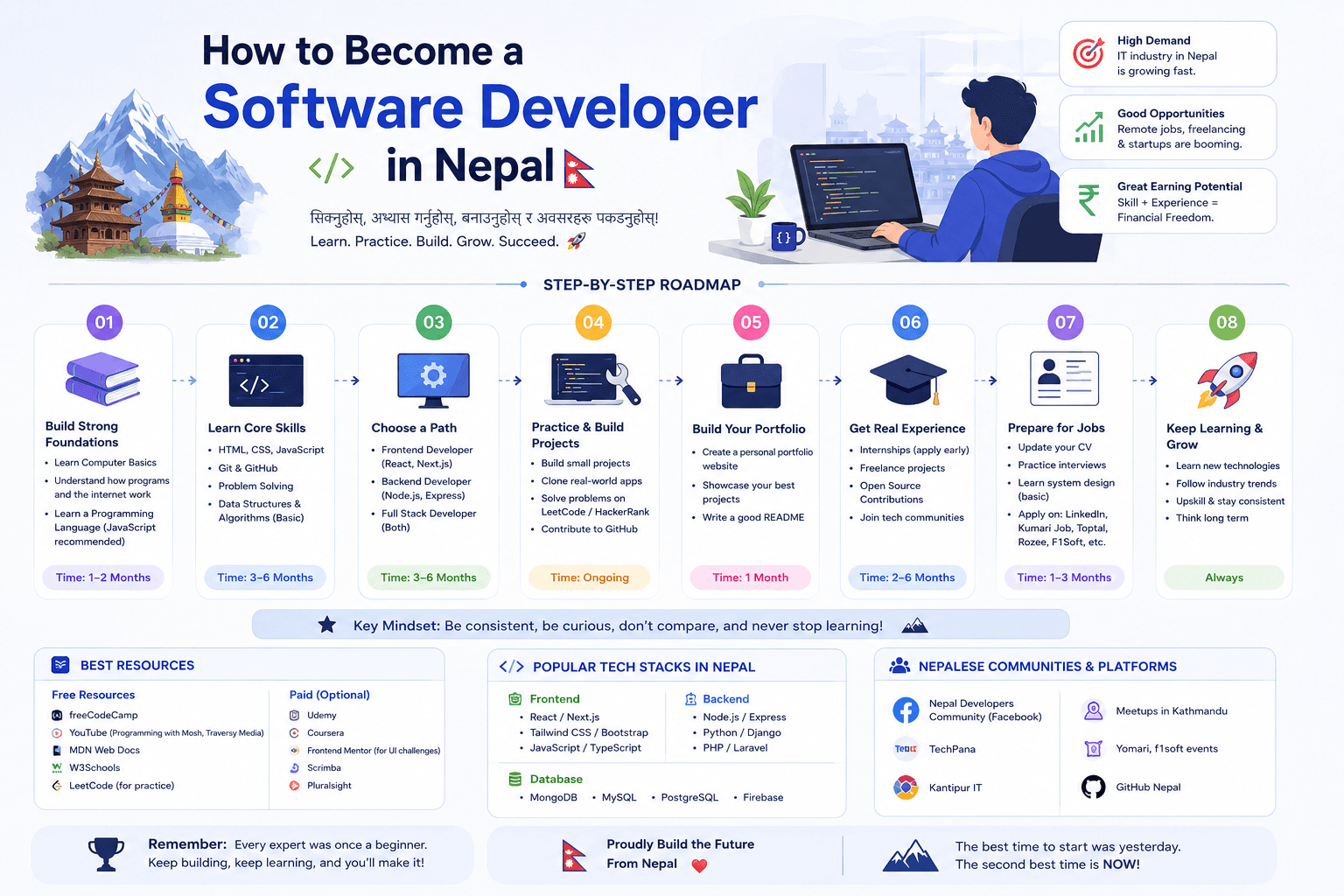
I am Sajan Acharya, a senior software engineer based in Kathmandu, Nepal. When juniors ask how to become a software developer in Nepal, they often expect a single course, a bootcamp certificate, or a list of languages. The honest answer is less glamorous and more useful: you learn by shipping small systems, reading other people’s code, and practicing judgment under real constraints. Titles and keywords matter for discovery, but employers hire people who can turn messy requirements into working software without creating chaos for the rest of the team.
Nepal’s market has changed. Remote roles, local product companies, agencies, and outsourcing shops all hire from Kathmandu and beyond. That variety is an opportunity if you treat your career like a product: clear skills, visible proof, and communication that makes collaboration easy across time zones. This guide is the path I recommend to people I mentor—and the same standards I hold when I evaluate software developer services work for product teams.
Start with fundamentals, not framework fashion
Before you chase every new library, get comfortable with how programs actually behave. Learn one language deeply enough that you can debug without Stack Overflow open in every tab. For web work, JavaScript or TypeScript plus a solid grasp of HTTP, databases, and Git will carry you further than five shallow tutorials. Understand variables, control flow, data structures, asynchronous code, and how errors propagate. Then learn how the browser and a server exchange data—status codes, headers, authentication cookies, and JSON payloads.
I also push fundamentals of computer science in practical doses: Big-O intuition for list and map operations, when an index matters in a database, and why mutable shared state causes bugs. You do not need a perfect academic background to become a strong developer in Nepal, but you do need enough theory to explain why one design will fail at scale. The best software developer on a team is rarely the person who memorized the most APIs; it is the person who can reason about trade-offs when requirements shift mid-sprint.
Build projects that prove you can finish
Hiring managers in Nepal and abroad skim portfolios looking for finished work. A half-done clone of a famous app is weaker than a smaller tool you deployed, documented, and improved after feedback. Pick problems you understand: a booking flow, an inventory tracker, a content site with auth, or a dashboard that charts real data. Ship a backend with clear endpoints, a frontend users can navigate, and a README that explains how to run it. Prefer boring reliability over flashy animations.
- One full feature path: signup, core action, and a clear success state
- Basic tests or at least structured error handling you can explain
- A public repo with commits that show iterative improvement
- A short write-up of decisions you made and what you would change
- Deployment somewhere a recruiter can click without installing locally
When you are ready to go beyond tutorials, study how real products are structured. Reading open-source issues, contributing a small fix, or rebuilding a feature from a product you use teaches more than passive video watching. Look at production apps you admire and reverse-engineer their flows: auth, empty states, error recovery, and how they name routes and components. That reverse engineering builds taste faster than another identical todo tutorial.
Learn how teams actually ship software
Individual coding skill gets you interviews. Team habits get you retained. Learn Git branching, pull requests, code review etiquette, and how to write a short design note before a large change. Understand the software development lifecycle at a practical level: clarifying requirements, estimating with uncertainty, testing what matters, and monitoring after release. Titles like Best Software Engineer get thrown around in job posts, but day-to-day excellence looks like small reversible changes, honest status updates, and code others can maintain.
If career titles confuse you—engineer versus developer, senior versus lead—read a clear comparison of software engineer vs software developer. In Nepal’s market those labels are inconsistent across companies. What stays consistent is ownership: can you take a vague problem, ask sharp questions, propose a design, implement it, and support it when something breaks at night?
Navigate Nepal’s hiring and growth reality
Expect interviews that mix coding exercises, system design conversations, and culture checks. Practice explaining your projects out loud. Be ready to discuss trade-offs, not just happy paths. For local roles, communication in English and Nepali both help depending on the team. For remote roles, written clarity is non-negotiable: async updates, recorded demos, and tickets that do not require mind-reading. Time zones can be an advantage if you deliver overnight progress that lands cleanly in a client’s morning.
Growth after the first job matters more than the first title. Seek codebases with real users. Volunteer for ownership of a subsystem. Mentor someone one step behind you—teaching forces precision. Aim toward lead software engineer in Nepal responsibilities only after you can consistently ship and raise the bar for others. Specializing later into frontend, backend, or full stack is fine; early breadth helps you see how pieces connect. Many people eventually deepen into paths like how to become a full stack developer in Nepal once fundamentals are solid.
Habits that compound for years
Set a weekly rhythm: code, read one strong article or chapter, review someone else’s pull request if you can, and write a short note about what confused you. Avoid tutorial hell by alternating learning with building. Keep a private log of bugs you fixed and why they happened—that log becomes interview gold. Stay curious about product, not only syntax. The best software developer I know in any country share one trait: they care whether the software helps a real person finish a real task.
Becoming a software developer in Nepal is achievable without leaving Kathmandu, and remote work expands the ceiling further. Start with fundamentals, prove you can finish, learn team delivery, and keep compounding. If you want guidance on a specific product or career step, get in touch and we can talk through a practical next milestone instead of another vague roadmap.