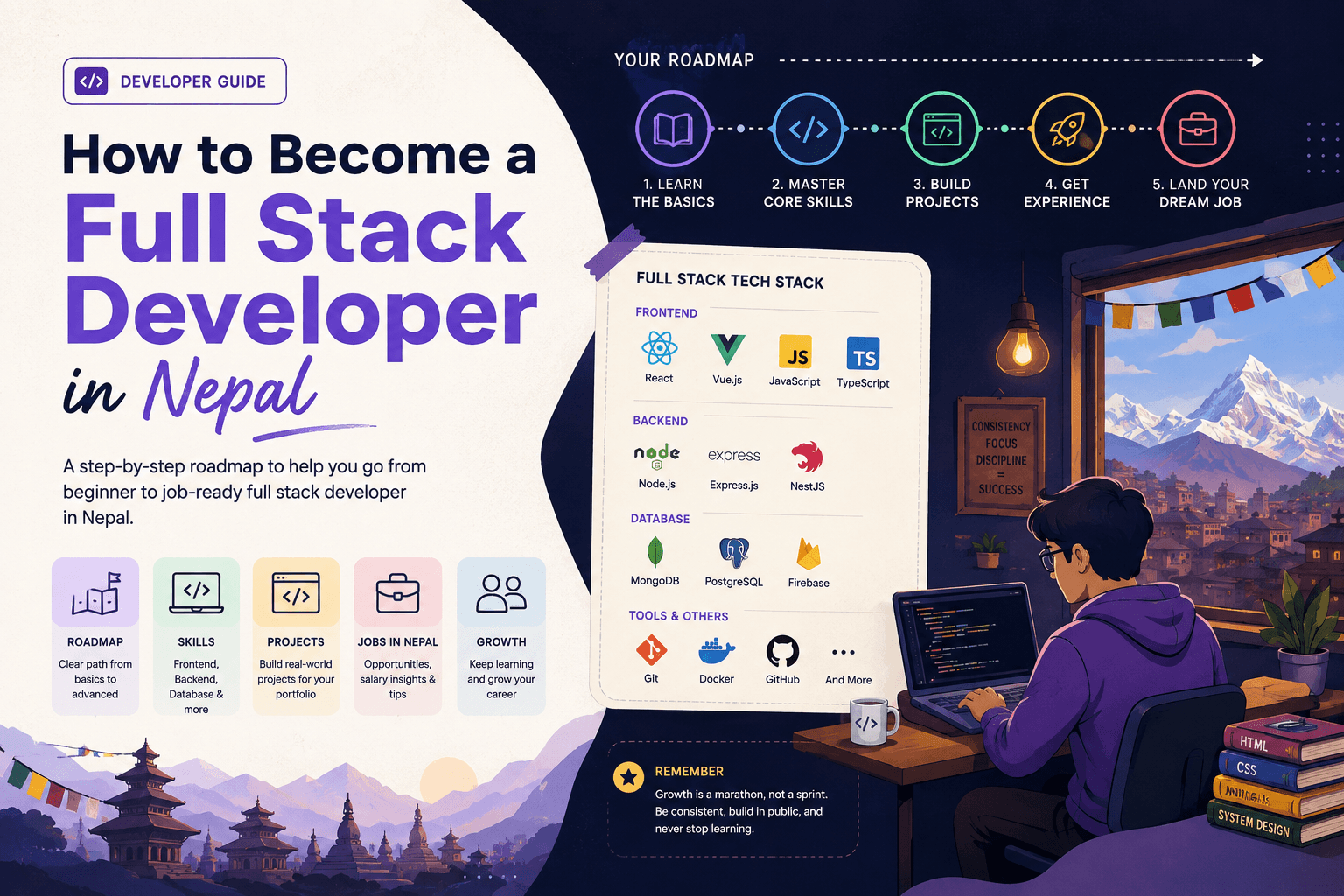
I am Sajan Acharya, a Senior Software Engineer and Senior Full Stack Developer in Nepal, based in Kathmandu. Becoming a full stack developer means you can move a feature from database and API to interface without waiting on three handoffs—and you understand enough of each layer to make sound trade-offs. In Nepal’s startup and outsourcing market, that range is valuable: small teams need people who ship, not people who only polish one silo. This guide explains how I recommend building that career with intention.
Full stack is not “know every framework.” It is competent ownership across the request path: UI behavior, API contracts, data integrity, auth, and enough deployment knowledge to get software in front of users. As a Lead software engineer in Nepal, I still specialize—often in JavaScript/TypeScript stacks—while staying literate enough to collaborate with specialists when systems grow.
If you want a MERN-specific roadmap, see how to become a MERN stack developer in Nepal. That path is one of the most practical full-stack routes available to learners in Kathmandu right now, but it is not the only valid one.
Choose a primary stack, then go deep
Pick one coherent stack early. In Nepal, MERN/Next.js and similar JavaScript full-stack paths are common because hiring and freelance demand are strong. Alternatives exist—Laravel, Django, Rails—but depth beats shallow sampling. Learn HTML/CSS/JS thoroughly, then one frontend framework, one backend framework, one primary database, and Git plus basic Linux. Breadth comes after you can ship.
TypeScript, testing habits, and API design matter more than collecting certificates. Employers notice whether your projects handle edge cases and failures. Senior Developer work shows up in naming, modularity, and the ability to explain why you rejected a fashionable library. A portfolio with two solid apps beats ten half-finished tutorial clones every time.
In Kathmandu and across remote Nepali talent networks, clients often evaluate English communication and reliability as heavily as syntax. Practice writing short update notes: what shipped, what is blocked, what decision you need. That habit accelerates trust whether you join a local agency or a distributed startup.
Balance frontend, backend, and product sense
Strong full stack engineers are not equally expert in every layer on day one. They are T-shaped: broad enough to integrate, deep enough in one area to lead. Practice UI accessibility and responsive layouts; practice API validation and authorization; practice schema design and indexes. Then practice the glue: shared types, consistent errors, and feature flags or env-based config.
Product sense is the hidden skill. Ask why a feature exists, who uses it, and what happens when it fails. Full stack developers who only translate tickets into code plateau. Full stack developers who clarify requirements and propose smaller releases become trusted partners to founders and PMs.
- Frontend: semantic UI, state, forms, performance, and accessibility basics
- Backend: auth, validation, logging, background jobs, and clear API contracts
- Data: modeling, migrations mindset, indexes, and backup awareness
- Delivery: Git workflows, code review, staging vs production, and monitoring basics
- Communication: written updates, demos, and trade-off explanations for non-engineers
Learn by shipping projects that look like work
Build two or three substantial apps rather than twenty tutorials. Include roles, auth, and at least one workflow that is not plain CRUD. Deploy them. Write architecture notes. Contribute to a team repo if you can—agency internships, open source, or campus projects with real users. Kathmandu’s market respects proof of delivery.
For a sequenced curriculum, follow how to learn full stack development step by step. If you are unsure whether to specialize in UI, APIs, or stay generalist, read Frontend vs Backend vs Full Stack: Which Path to Choose?. The right path depends on your strengths and the jobs you want, not on which title sounds broader on LinkedIn.
When you demo projects in interviews, narrate decisions: why this database shape, why this auth approach, what you would improve with more time. That narrative is often what separates a Junior who “used React” from a candidate ready for ownership.
Seek feedback loops outside your own head. Code review from a stronger engineer, even once a month, compounds faster than silent solo grinding. If you cannot find a mentor locally, publish a project walkthrough and ask for critique in communities where people actually read code. Humility plus iteration beats ego plus tutorials.
Grow into senior impact in Nepal’s market
Junior full stack work is feature implementation. Mid-level work adds ownership of modules and better estimates. Senior Full Stack Developer in Nepal impact includes mentoring, cutting risk from architecture choices, and improving how the team ships. Practice code review. Learn to say no to scope that breaks quality. Study production incidents—your own or postmortems online.
Remote work expanded opportunities for Kathmandu engineers, but it also raised the bar on async communication and reliability. Treat English writing and calendar discipline as career skills. Keep a simple personal changelog of systems you have improved; it becomes evidence during promotions and client conversations.
Measure your progress with outcomes, not hours watched. Did you deploy something? Did a user complete a workflow? Did you reduce a production error? Those signals matter more than finishing another playlist. Consistency over months is how Junior work becomes mid-level ownership, and how mid-level ownership becomes senior judgment.
When you want structured help on a product or mentorship-style collaboration, my full stack developer services page outlines how I engage with teams. The goal is the same whether you are learning or hiring: ship software that users trust, then keep making the path to production safer and clearer.