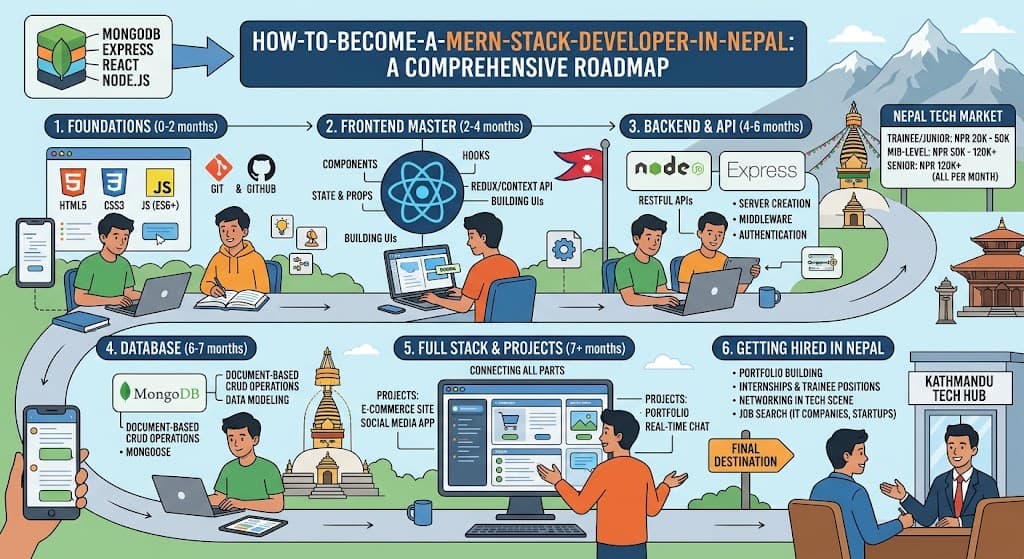
I am Sajan Acharya, a Senior Software Engineer based in Kathmandu, Nepal. When juniors ask me how to become a mern stack developer, they usually want a shortcut list of tutorials. Tutorials help, but employers and clients hire people who can ship a feature end to end: model data in MongoDB, expose a secure Express API on Node.js, and build a React interface that survives real user behavior. This guide is the path I recommend if you want to grow into a Senior MERN Stack Developer in Nepal rather than someone who only clones CRUD demos.
MERN—MongoDB, Express, React, and Node.js—fits Nepal’s product and outsourcing market well because JavaScript spans the whole stack. You can learn one language deeply, then specialize. The same stack powers SaaS dashboards, marketplaces, clinic portals, HR tools, and internal ops systems for local startups and remote clients. Demand stays healthy because companies can hire one engineer who understands both the browser and the server, which reduces coordination cost on small teams.
If you want a broader career frame beyond MERN alone, my guide on how to become a full stack developer in Nepal covers complementary skills and hiring expectations. Use that article for the generalist path; use this one when you are ready to commit to MongoDB, Express, React, and Node as your daily tools.
Build a foundation before chasing frameworks
Start with JavaScript fundamentals: closures, promises, async/await, modules, prototypes versus classes, and how the event loop behaves under I/O. Add TypeScript early. Most professional MERN codebases in 2025–2026 use TypeScript on both client and server. Learn Git branching, pull requests, HTTP status codes, REST basics, and how JSON moves between browser and API. Without that base, React hooks and Express middleware feel like magic spells instead of tools you control.
Next, understand the browser: DOM events, forms, accessibility basics, CORS from the client’s point of view, and network-tab debugging. On the server side, understand processes, environment variables, and why you never put secrets in the frontend bundle. These habits separate hobby projects from production work. As a Lead software engineer in Nepal, I still interview candidates on these fundamentals before I ask about Redux or aggregation pipelines.
Also learn to read error stacks calmly. Half of junior growth is becoming comfortable when something breaks. Reproduce the bug, isolate the layer, write down what you expected versus what happened, then fix it. That discipline will matter more in your first job than memorizing every Array method.
Learn the four MERN pieces in a deliberate order
I suggest Node.js and Express first so you can build APIs and talk to a database. Create routes, middleware, validation with a library such as Zod or Joi, and consistent error responses. Then MongoDB: documents, indexes, relationships via references or embedding, and basic aggregations. React comes next with components, hooks, routing, and how to fetch and mutate data safely. Finally, connect them: auth with JWT or sessions, protected routes, validation on both sides, and error handling that the UI can display clearly.
- Node.js + Express: routes, middleware, validation, auth, and structured errors
- MongoDB: schemas, indexes, migrations mindset, and query performance basics
- React: component design, forms, loading/empty/error states, and routing
- Integration: TypeScript shared types, env configs, and end-to-end feature slices
- Ops lite: Docker basics, logging, and deploying to a VPS or PaaS
Do not learn all four in parallel at the same depth. Parallel learning often produces shallow confidence. Finish a small Express API with MongoDB before you invest heavily in advanced React patterns. Then rebuild the same domain with a polished UI. That sequence trains the mental model of a request traveling through the stack.
Build projects that prove senior-ready judgment
Portfolio projects should look like products, not tutorials. Build a multi-role app—for example a job board, clinic booking tool, inventory system, or freelance marketplace—with login, roles, and at least one non-CRUD workflow such as search, notifications, file uploads, or a payments sandbox. Document your API. Write a short README that explains architecture decisions. Deploy it. Recruiters and founders in Nepal and abroad trust running software more than certificate screenshots.
When you are ready to compare ecosystem choices, read MERN vs MEAN Stack: Which Should You Choose?. Knowing why React won for your project—and when Angular might still make sense—shows maturity. Also practice reading other people’s code on GitHub; much of a junior’s growth happens by debugging unfamiliar repositories and noticing how seniors name modules, handle errors, and structure tests.
Aim for quality signals in every project: seed data scripts, a simple Dockerfile, environment example files, and at least a few automated tests around auth and core business rules. Those extras tell hiring managers you have seen what production needs, even if your first job is still ahead of you.
Get hired and keep leveling up in Nepal
Kathmandu’s market values clear communication, reliable delivery, and the ability to own a feature without constant hand-holding. Contribute to open source when you can, write short technical notes about bugs you solved, and practice explaining trade-offs in plain English. Internships, freelance MVPs, and agency work all count if you can show outcomes. Keep learning testing (API tests and critical UI flows), security basics (XSS, CSRF, injection), and performance (indexes, N+1-style query waste, bundle size).
If you are a founder evaluating talent instead of becoming one, see how to hire a MERN stack developer for your startup. And if you want hands-on help building or mentoring on a real product, my MERN stack developer services page explains how I work with teams from Kathmandu and remotely.
A realistic timeline and mindset
With consistent daily practice, many motivated learners can ship a credible first MERN full-stack project in three to six months. Becoming interview-ready for mid-level roles often takes longer—closer to a year of building, breaking, and fixing real systems. Senior-level judgment compounds over years of production incidents, refactors, and mentoring. Treat the roadmap as a loop: learn, build, ship, review, and deepen.
Avoid the trap of endless course hopping. Pick one curriculum path, finish projects, then specialize. Join communities where people review code honestly. Ask for feedback on architecture, not only on whether the feature “works on my machine.” That loop is how I grew from writing Express routes to owning products as a Senior MERN Stack Developer in Nepal—and it is still how I stay sharp as a Lead software engineer in Nepal working with startups and product teams.