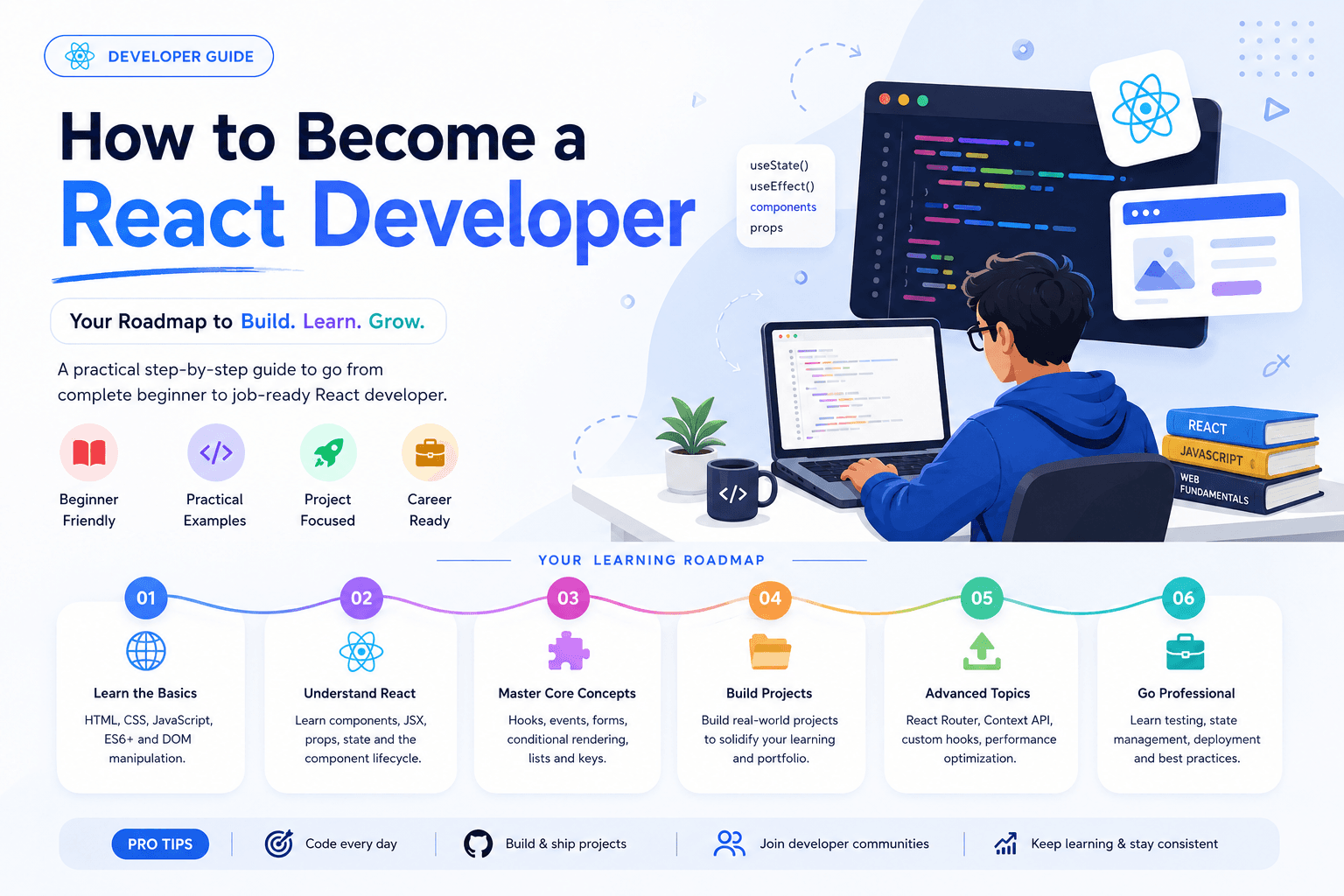
I am Sajan Acharya, a senior software engineer based in Kathmandu, Nepal. People ask how to become a React developer because React still dominates product UI work—from SaaS dashboards to marketing sites and hybrid mobile shells. The path is clearer than it looks: strong JavaScript, deliberate component thinking, real projects that handle messy states, and the humility to learn the ecosystem without drowning in it. Certificates help a little. Shipped interfaces help a lot.
React is a library for building user interfaces with components and declarative rendering. That sentence is easy. The craft is harder: managing data that arrives asynchronously, keeping performance acceptable as trees grow, and structuring folders so a teammate can find the truth. When I deliver React developer services, clients hire that craft—not a résumé line that says “knows hooks.”
Master JavaScript before you memorize React APIs
You cannot shortcut language fundamentals. Closures, promises, async/await, array methods, modules, and how `this` behaves in different contexts show up constantly. TypeScript is worth learning early because product teams increasingly expect typed props and safer refactors. Understand the DOM well enough to know what React abstracts for you. Learn HTTP basics so loading, error, and retry UI are intentional instead of accidental spinners forever.
I recommend building a few small vanilla JS apps before going deep on React—fetching an API and rendering lists, handling forms, and managing simple client state. That background makes hooks feel like tools instead of magic. It also helps in interviews when someone asks why a re-render happened or how to avoid mutating state. React developers who only copy patterns from tutorials struggle the first time production data is partial, slow, or contradictory.
Learn React in layers, not as a pile of libraries
Start with components, props, state, effects, and composition. Practice lifting state thoughtfully and colocating state when a single component owns it. Learn controlled forms, lists and keys, and conditional rendering that stays readable. Then add routing, data fetching patterns, and a styling approach your target jobs use. Only after that should you reach for heavier state libraries—and only if local state and server-state tools are not enough.
Modern React also means understanding where interactivity belongs versus where the server can render HTML for speed and SEO. Frameworks built on React change the defaults, but component thinking remains the core skill. If you are deciding whether React is even the right UI bet for a product, read how to choose React for modern web apps before investing months in the wrong stack for your constraints.
Prove skill with projects that survive real usage
Portfolio projects should show judgment under incomplete requirements. Build something with authentication, paginated lists, optimistic updates, empty states, and accessible forms. Deploy it. Measure basic performance. Write a README that explains architecture choices. Hiring managers in Nepal and remote companies can tell the difference between a tutorial clone and a project you debugged at midnight because a race condition appeared.
- Solid JS/TS fundamentals and Git habits you can explain aloud
- Component design that keeps props honest and effects purposeful
- Data fetching with loading, error, empty, and success states
- At least one deployed app with routing and real API integration
- A habit of reading diffs carefully and writing reviewable pull requests
Also study failure modes early. Many juniors ship apps that work on happy paths and collapse on refetch, stale cache, or rapid clicking. Learning how to avoid common React developer mistakes will save you months of silent quality debt. I still catch myself reaching for an effect when a derived value would do—experience is noticing that faster and fixing it before review.
How hiring works for React roles from Nepal
Expect live coding or take-homes that test component structure, state updates, and asynchronous UI. Be ready to discuss trade-offs: client state versus server state, when to memoize, how you test critical flows, and how you handle accessibility. Remote interviews reward clear narration. Local product interviews may dig into collaboration with designers and backend engineers. Either way, show that you can partner across the stack, not only style buttons.
Kathmandu’s talent market includes agencies, startups, and global remote teams. English written communication is often the gating skill after coding ability. Share progress with screenshots or Loom-style demos. Ask clarifying questions before coding in take-homes. Those habits signal senior potential even when you are still mid-level on paper. Keep a short public changelog of what you built each month—recruiters remember concrete outcomes better than vague claims about passion for UI.
Keep growing after the first React job
The first job teaches production constraints: design systems, legacy class components, inconsistent APIs, and release pressure. Lean into those constraints. Volunteer to improve shared components, document patterns, and reduce bundle size on a critical route. Learn enough backend to debug integration issues without waiting helplessly. Breadth makes you more valuable; depth in React performance and architecture makes you harder to replace. Pair with designers when you can—understanding spacing, hierarchy, and interaction cost will improve your component APIs as much as any library tutorial.
Becoming a React developer is a sequence of deliberate practice loops, not a single course. Build foundations, learn React in layers, ship proof, study mistakes, and communicate clearly from Kathmandu to wherever your teammates sit. Revisit old projects every few months and rewrite one painful module with what you know now; that comparison is one of the fastest teachers available. If you want help reviewing a portfolio direction or scoping product UI work, get in touch and we can outline a concrete next step.